
Journal
This journal is an evolving space. We post new material regularly. Visit us again!
Letters from Minnesota
WDA Minnesota has launched a new feature, Letters From Minnesota.
We invite you to contribute your Minnesota Letter to be featured in the Writers for Democratic Action Minnesota newsletter. We are seeking writers from all over the state of Minnesota. We are looking for flash essays or stories or poems. Here are some suggestions or writing prompts:
- What are the concerns in your area?
- What are the ways the community is dealing with that concern?
- What is happening in your community to strengthen democracy?
- Tell a story that is connected to your particular landscape
Letters From Minnesota is an opportunity to connect with and learn about Minnesota writers and their locale. WDA-MN is a non-partisan organization. Writers of all kinds have a unique ability to harness the written and spoken word for good, for truth, for justice and equality, and for the rights of all. WDA–MN aims to advocate for writers and for the written word as well as to empower writers to join the fight to protect our democracy. We support independent journalism, libraries, and indie bookstores. We believe in participatory democracy. Voting is important, but we can have more impact if we take action in our communities in word and deed.
Writers for Democratic Action Minnesota has arranged public poetry & writers' events, hosted a table at the Rain Taxi Minnesota Book Festival, published monthly newsletters that offer resources, opportunities, and curated news reports. The national WDA organization also has a Substack and invites writers anywhere in the US to send in essays for publication.
Send us your contributions at hello@writersfordemocraticaction.org.
The Waters Call
by Diane Jarvenpa
My father was a boy of the wilderness. A boy of the north country. He grew up in Embarrass, Minnesota and was raised by his father and extended family when he lost his mother to the Spanish Flu pandemic at the age of two. He was shy and he found himself often walking the woods. This was his sanctuary. He went to Ely Junior College and found a friend and mentor there — Sigurd Olson. The guidance and friendship over the decades with this writer and environmentalist cemented my father’s ideas about the sacredness of the wilderness.
In the summer of 1937, he joined the Civilian Conservation Corps that was directed to build portages in the Boundary Waters Canoe Area. From that experience he went onto the University of Minnesota and majored in fisheries biology. After returning from service in WWII he got a job with the Department of Natural Resources. His main job in the field was to help build and maintain rivers and streams to make them healthy and viable environments for fish and other wildlife. It was said at his funeral he walked every river and stream in this state.
The Glass Breakers
by William Meissner
Beware. They might approach your car any time:
In the splintering light of early morning,
or out of the frightening silence of night.
They are the glass breakers.
They arrive suddenly with guns, with tear gas,
with blunt instruments,
their dull fatigues blending in so it's hard to distinguish them
from the grey shadows in an alley.
There are no laws for them. Anger is the only law they follow.
Do not try to speak to them. They have no use
for words or declarations of innocence--
their mouths are sealed tightly under ash-colored masks.
They’re idling right now in vehicles
on your neighborhood streetcorner, just waiting
to angle in front of your car
and block the path to your future.
So please beware. They're ready
to strut up to your driver’s side window, anxious
to break through the glass, anxious
to send sharp icy pieces flying into your face,
blinding you like bullets, like tears.
Letter from a Besieged City in America
Margaret Hasse
So alone, each of hundreds in our north
star state––beings sniffed out, run
down, dragged, tied up, shoved
in, head-cracked, driven, dumped
in dark places, disappeared.
So alone, the rest of us snugged at home
hearing news of atrocities, watching
videos of masked men in our home-
town toting machine-like guns, grabbing,
kicking, shooting, and we who knew
not or actually knew the taken, first feel
unbelief, numbing fear, geysers of inward
anger and sorrow for the numberless hurt
and the named dead.
We became roused and risen to
outward acts: deliver food, guard
school children, record kidnappings with
eyes and cameras as on the boy in
a blue bunny hat, send money, join
groups, trail black cars, shriek alerts
with whistles, light vigil candles, wield signs,
march, lay flowers on the bloody snow, say no.
A whole community besieged becomes
a whole community of care, protest and
resistance, a testing ground for whether
kindness and the Constitution can hold up
against the battering ram of govern-
ment run amok as we gather in our cold time,
our beautiful city under attack, to hold
hands with neighbors whether citizens or
citizens-to-be while spokespeople for
the outrage name-call and hob-gobble truth.
We here know what we saw and see,
and gradually then all at once, people
across the country are paying attention,
posting their support, writing the wrongs
to their leaders while Springsteen
sings his “Streets of Minneapolis,” a song
like a flag to carry, and Judge Biery near
the southern border in the lone star state
frees from detention a man and his young
son stolen from Minnesota, noting in
his order that “the case has its genesis
in the ill-conceived and incompetently-
implemented government pursuit
of daily deportation quotas . . .” –– all
just and sympathetic action from all
over the country eases our city’s
isolation and bolsters hope
our democracy will endure.
reprinted from New Verse News
To the Republic
Athena Kildegaard
It is hard, right now, to think
of America, my country, it no longer
holds together inside its borders.
Four decades ago, every school day,
I asked one of the twelve-year-olds
in my charge to lead us in the Pledge
of Allegiance. It was the law, this recital.
As good a way as any, I thought, to begin.
Words, words, slippery as jello cubes,
hardly join, now, to anything real.
My heart beats, my hand firms itself
to my chest—this friction, this viva--
but my tongue dare not lift, my lips
not open, my body not burst
with air, with light. America, where
have you gone?
You are in Minneapolis,
America, handing out scarves and hats,
standing beside your neighbors, lifting
whistles to your lips because your lips
have power, your breath has power,
you are teaching us how to be Americans.
reprinted from New Verse News
A Light in the Storm: How ISAIAH Minnesota Works for Change
by Margaret Todd Maitland
Last night I stood on a street corner in my St. Paul neighborhood holding a candle. The night was dark and the sidewalks icy. The temperature was -10. A handful of friends and neighbors had gathered on this corner and on corners all over our cities to honor the life—and protest the death– of Alex Pretti, at the hands of ICE agents. After the shocking murder by federal agents of Renee Macklin Good a few weeks ago, we couldn’t believe it had happened again.
Like the DAY OF TRUTH AND FREEDOM rally a few days earlier, on January 23 where a huge crowd marched through bitter cold in Minneapolis, this action was organized in part by ISAIAH Minnesota. I’ve been involved with ISAIAH for about nine months, and I am still surprised at what I’ve learned and how I’ve changed.
On a frigid morning last December, I drove to the Minneapolis Convention Center to join 5,000 members of ISAIAH. It would be an eight-hour meeting to vote on our agenda for the coming year. ISAIAH is a community organizing coalition working to build power for a multiracial democracy, a caring economy, and a thriving planet. We would learn about the issues as well as strategies to combat authoritarianism. The title of the gathering was “A Light in the Storm.” I was excited but skeptical. What could a grassroots organization of volunteers really accomplish?
The parking ramps near the convention center were full, and during the long walk across a bridge over I-94, I reviewed my reservations. I’m an introvert. I do not like being in the same room with 5,000 people. I do not like recruiting others for a cause. I hate discussing public policy. But I had joined ISAIAH because I felt a deep horror at what was happening to our country under Donald Trump. I wanted to stop feeling helpless. I had a strong desire to DO SOMETHING.
ISAIAH brings together people from an unlikely collection of local organizations: 200 churches; synagogues, mosques, and Buddhist centers; 512 small and family-owned child care centers; Black barbershops; manufactured home residents; and rural grassroots organizations. I was impressed by ISAIAH’S ambitions: to inspire these folks with great hopes and strategic realism. But what goals could we all agree on?
The goal-setting process began in a very personal way. Six months ago, each organization had passed out a questionnaire asking “What issues concern you and your family?” The top issues in my area of the Twin Cities were elder care, access to mental health services, and programs for youth development. I liked the way ISAIAH had gathered information from the bottom up, putting democracy into action. Truly grass-roots.
The responses from the entire membership boiled down to Affordability, Dignity, and Community, with specific needs like affordable childcare for families and a living wage for childcare workers; helping families buy homes; fully fund high-quality public education and public youth programs. The ambitious list then would become The People’s Agenda, which ISAIAH members will bring to their party’s local caucus meetings to be hashed out within the party and at the legislature. By forging deep relationships with public servants at the state, county, and local level, ISAIAH, along with its political, 501(c)(4) arm Faith in Minnesota, has propelled the Minnesota legislature to pass important new laws. During the 2023 session, known as the “Minnesota Miracle,” ISAIAH had big wins: laws guaranteeing paid family and medical leave, a ground-breaking clean energy bill, restoring voting rights to the 55,000 people on parole, probation, and supervised release; guaranteed time off work to vote. Rent stabilization.
It took a while to sink in: ISAIAH has really changed peoples’ lives! I could feel the muscle behind the high hopes, the way people working together with sophisticated strategies could wield real power.
We all have the chance to weigh in on the issues that matter to us. At the party caucuses coming up on Tuesday, Feb. 3, members of Faith in Minnesota will bring our People’s Agenda. We plan to volunteer as a “People’s Delegate” and to influence our party’s candidates around our agenda.
Again I feel my reluctance to engage with big groups. I have tried and not been very successful at inviting others to join me in learning about ISAIAH. But I have exerted myself beyond my comfort zone, and I think that’s a good thing. Now that the stakes are suddenly so high, with our neighbors being dragged off the streets and disappeared, I feel the energy for justice that surges around us.
Last night when I returned from my street corner, my candle was still burning. I imagined the view from a drone gliding over our cities, thousands of tiny flames glowing in the cold.
Then I learned from the national news that Minneapolis—with our care for our neighbors, our peaceful protests, our actions to stop the march of authoritarianism—has inspired people around the country. Around the world.
We can be a light in this storm.
Margaret Todd Maitland is a St. Paul writer and a member of ISAIAH through St. Mary’s Episcopal Church.
They Think
by Stanley Kusunoki
They think that murdering us and then blaming us will silence our voices
They think telling lies and disregarding the rule of law will keep us behind our doors
They think that hiring undertrained thugs “to keep the peace” will make us give in
They think but do not know anything about us
Their hatred makes our love more strong
Their lies make our truth more durable
Their violence makes our peace more formidable
Who do they think we are? Those traitors to the Constitution
Sitting snug and smug in their offices?
They are not here. We are. Steeled by the northern winter
Warmed by the bonds of freedom and justice
They think they will wear us down
Ha! Come stand with us in sub-zero bluster
You will not last a minute here. You are not us.
You are not Minnesotan.
The Children’s Hour
When I’m upset, not quite devastated, but blue,
which is often these days of our country’s downhill
disaster, I pull out my old faithful poetry anthologies,
like Untermeyer’s The Golden Treasury, as I did today,
and read aloud to myself poems that rhyme, that gallop
across the page, my voice thrilled to keep pace
with the glorious upbeat regularity of rhymers
like Henry Wadsworth Longfellow, bearded man
in a greatcoat featured in my deck of Authors
playing cards, along with Robert Lewis Stevenson,
and others who kept the beat going, and so, O.K.,
they are mostly men, but amiable pals from my grade
school years, with easy-to-memorize tales of fleeting
happiness, historical bravery, and great love
as in “The Children’s Hour,” “The Swing,” and
“The Midnight Ride of Paul Revere,” which made me
imagine the belfry lights and clatter of a horse’s hooves,
and after I closed the book, I sat, in tears, for a long time
hoping as if with a child’s belief in magic for a hero
like that to come at a clip into our cities, into our lives
and draw us out, to the streets, to rally again for freedom.
— Margaret Hasse
Margaret Hasse is author of three collections of poetry, Milk and Tides (Nodin Press, 2008), In a Sheep’s Eye, Darling (Milkweed Editions, 1988), and Stars Above, Stars Below (New Rivers Press, 1984), two of which were finalists for the Minnesota Book Award. Milk and Tides won the 2009 poetry prize of the Midwest Independent Book Publishers Association. In additional, she co-edited Rocked by the Waters with Athena Kildegaard and edited A Little Book of Abundance, a chapbook with poems of gratitude by eleven poets.
Her books have been prizewinners and bestsellers. Margaret is recipient of grants and fellowships from the National Endowment for the Arts, McKnight Foundation, Loft Literary Center’s Career Initiative Program, Minnesota State Arts Board, and Jerome Foundation. She also works as a consultant to arts organizations, teaches poetry, and curates a poetry book reading series.
To learn more about her many projects and her consulting work, check out her website https://www.margarethasse.com/
Images of Democracy and Resistance
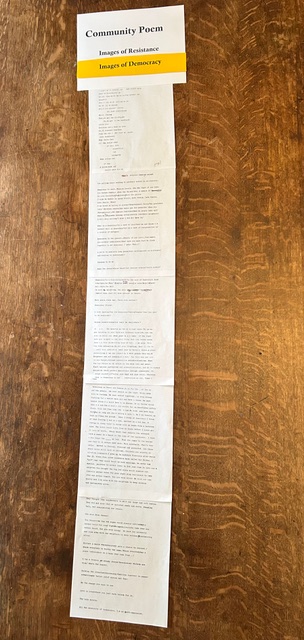
Rain Taxi Book Festival 2025 Community Poem
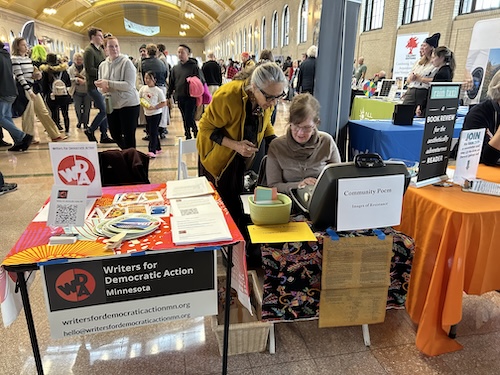
WDA-MN hosted a community poem written by attendees of the festival held November 8, 2025 in St Paul.
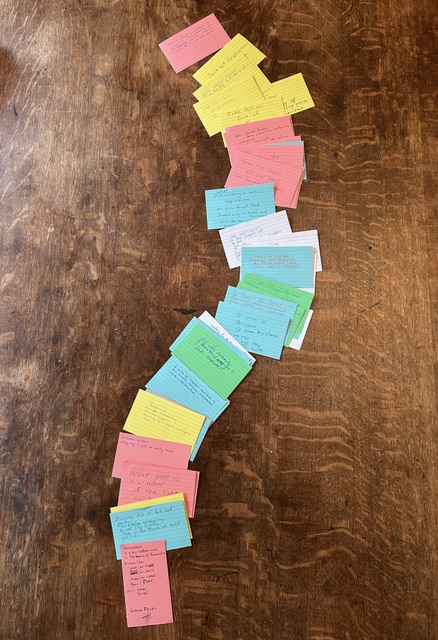
Folks wrote lines on index cards that were typed onto pages to create a beautiful material artifact for the day.
"it all comes down to paying attention..."
Community Reflections
Over two decades ago I lived with my husband and our two small children in a comfortable house built on the side of the basin that dropped sharply to the city of Guanajuato, Mexico. Like everyone we knew—gringos and citizens—we hired a woman who came once a week to clean the four levels of our house. Over our three years there we grew to love Lourdes and her husband, Juan.
The time came for us to return to the United States. One day shortly before the moving truck arrived, Juan and Lourdes came to visit. They came to ask that we take Juan with us to Minnesota. He was small and could make himself invisible at the border. He was a hard worker; he'd find his way. Por favor. Please.
I live now not far from Appleton, Minnesota, home of the shuttered Prairie Correctional Facility, a prison owned by CoreCivic, a private prison operation based in Tennessee. ICE is on the verge of turning the prison into an immigration detention facility. Helicopters have been seen lowering containers onto the roof of the prison. The prison has stood empty so long that it's filled with mold, or so we've been told.
Appleton is a dying rural community. Many things have conspired to sicken it: school consolidation; the shift away from railroads as major transporters of goods and people; the loss of family farms to big ag; the disappearance of opportunities for young people. Some folks in Appleton are eager for the Prairie Correctional Facility to open again, and state legislators from the region have been lobbying for its reopening.
Meanwhile, western Minnesota is flourishing in large part because of the influx of immigrants. Public schools have more students; dairies and the complex of meat production oeprations depend on immigrant labor.
Right now there are job listings for border patrol agents in towns all around me: Chokio, population 411; Donnelly 223; Milan 416; Graceville 511; and many more.
Is this the work we want for our young people: rounding up and detaining other human beings so they can be held in dismal conditions without legal counsel or contact with their families? Do we want our neighbors to behave as if some people—strangers, brown people, innocents—are beyond the protection of the law? Do we want our neighbors to pay their rent, feed themselves and their children, by carrying out jobs that go against everything we as citizens of the United States of America hold to be self-evident?
I fear for our neighbors and our communities. Most of all I fear for people like Juan and Lourdes, good, loving, honest people whose American dream is quickly becoming a nightmare.
— Athena Kildegaard
Postcards to Pete
Postcards with timely quotes, sent by a constituent to Representative Pete Stauber of Minnesota District 8
'Postcards to Pete' is an attempt to resist, in a small way, the current daily shattering of democratic norms. Each postcard features a handwritten, pro-democracy quote that a politician such as Representative Pete Stauber of Minnesota District 8 might view as part of his own political and ethical heritage. So far I’ve quoted the Declaration of Independence, the U.S. Constitution, Ronald Reagan, Russell Kirk, and Pope Leo XIV. Through regular (most often weekly) social media and blog posts, I'm attempting to create a structure for these reminders to gain strength through repetition. I am choosing to believe there is still common ground, a shared history and ethics that Americans across the political spectrum can draw upon, and that can lead some of us back to each other.
— Julie Gard

and sent hither swarms of Officers to harass our people, and eat out their substance.”
- The Declaration of Independence, 1776
Crossing Cuyahoga
"Crossing Cuyahoga" is a piece of creative nonfiction that tackles Lou Reed and other rock 'n roll animals, misrepresentation of Native peoples, burning rivers, transplanted livers, and a possible end to the Trump era...
— Carter Meland
from
The Massachusetts Review, Volume 61, Number 4, Winter 2020, pp. 742-746
between two shores
What is the eagle stealing
as its long wings
grasp and climb the wind
far up in the silence
with two birds chasing?
On the highway
beneath the ascending flights
tangling dark birds in pursuit.
Already too late, already the swaying
shadows fail and outwit the tender watch.
What rides on an eagle’s indifferent motion
in the rising thermal currents as the sun glances
off the wide surface of the lake
what waves or sky or emptiness?
What is the news
what wars are beginning
what are the eagles dreaming
as streams tumble down the granite face
break free from the hill, gain flight
what breaks free
arrives at its destination?
— Sheila Packa
from cloud birds
Standing on the delicate edge ... democracy
The great composition
The reflections and the differences
The vantage point of bloom and fade
The history of that pull away from the jingo
The thunder of the other kind of colonization
This land, this land
This land is your land
Not this land is all mine
The beautiful fragile thing
The far-reaching antidote to kings
Not just palimpsest
Not just parchment and inkwells
A promise
Not moral surrender or theory
Vision, the constant equation
Of we, we, all of us
In full detail of our becoming
Of our multitudes, our applause
for deep understanding
Of the historic
The cured, the mended
Of the human state of impulse
That creates grace
Of memory, to remember
Everyone, those lost, those fallen
The great experiment witnessed
Not to be drop kicked
Not in need of mouth to mouth
Not a murder victim
This is always a becoming
Not just an abstract
An oasis of purpose
A swearing in of hope
Non-fiction and poetry
Open doors
A complete picture
A shimmering
The listening and the telling
The language of the whole
Including shame, the stain, the grief
The wildfire, the hunger
But never a final elegy
— Diane Jarvenpa
Psalm for the Slightly Tilted
This is not
a good year.
But it has
witnesses.
When you see them protest the powerful,
because who else
protests the powerful,
they stand
like flagpoles outside the courthouse
after the northeaster.
They came with
the wrong shoes
for revolution.
Still,
they showed up.
They come in clothes
that gave up first
beneath
the clouds
torn as boiled hospital sheets
Comfort, Lord,
their bodies—
each a question mark
doing time
as a coat rack,
hung with borrowed jackets.
They are your legion
of bent spoons.
They are the only ones
who showed up—
with their orthopedic flair.
They cant off-rhythm
and mean it.
These are my kind of people:
no tears—just
steam from a kettle
that never quite boils.
In times like these don't forget us:
the lopsided leaning
on one another like paperbacks.
Comfort us standing—
half scarecrow
half saxophone
with a squawk.
Comfort us sitting—
which we do
like furniture
of the modestly ambitious.
In the year they come for us
watch my people
make protest signs
out of old pizza boxes.
Watch—there are no boring people
which is unfortunate.
You'd think statistically
we'd get at least a few—
one-speed souls
with just meh stuff to do.
But none of them
are dull.
Each
carries
a suitcase
held together
by scotch tape.
Comfort them standing up—
where stiffness
becomes state policy.
Their bodies,
folded umbrellas.
Comfort them sitting—
in that collapse
called calm.
These are your coffee stained saints
who rise not with trumpets
but with Advil.
They stand
and wait
creased like maps
of a country
that doesn't exist anymore.
— Ilya Kaminsky (posted with permission)
Descendants of Black Folks Who Don't Have Last Names
Without the recipe of colonization,
there would be no birth of this nation.
No gunpowder, no graveyards on stolen ground—
no America.
Without tribal blood,
without kidnapped gods—
there. would. be. no. America.
You preach "land of the free"
but bind wrists, break backs,
quiet lynchings, hollow screams—
contradiction is your constitution.
You protect animals from cruelty,
then legalize bull bucking
as cowboy culture.
Call genocide a jersey.
You mount foreign founding fathers
on land they stole in armed robbery,
spill blood and name it Thanksgiving,
promise clean water—
but Flint still drinks lies from plastic bottles.
You say "equal opportunity."
We say: Equal for who?
It's only fair when the skin is fair.
Only justice when the judge shares your genes.
Plant drugs in our halls,
guns in the gutter,
poison pipelines so branches never root.
You turn classrooms into cemeteries,
blackboards wet with chalk and blood dreams.
Every backpack—
a body bag
waiting to zip shut.
Beneath your red, white, and blue,
Black lives suffocate under white lies.
We are the legacy you can't unwrite,
history that sits in your mouth
with teeth too Black to extract.
— Dralandra Larkins
What Democracy Means To Me
Democracy is messy. By nature, it is tension. And arguing. I miss when politicians were proud of bipartisan triumphs. I don't believe it was ever easy, but it was necessary. Maybe painful at times: to have to listen, reach across the aisle, consider another's perspective and offer concessions; resulting in the slightest move of the needle—where an individual may come away dismayed at the process because they didn't get their way, yet instead—something greater was achieved. Maybe our people grew tired of compromise. But compromise is what sets our country apart. A healthy Democracy is tedious, exhausting, it involves rhetoric and challenges, debate and returning to the wheel. Democracy is loud. It allows for a multitude of voices to rise. It's a cacophony of differences. Where somehow, we all move forward together, sometimes in the slightest way. We should never want Democracy to be unilateral, or easy. It shouldn't represent one party, the president or one region. By nature it is for all the people, by the people, and the people need to lead the country again, with politicians returning to their roles as civil servants of the people.
— Cole W. Williams
In Memoriam for a Strong DFLer
There's a photograph going around of Melissa and Mark Hortman from the DFL Humphrey-Mondale Dinner last Friday night. It's likely the last photograph of the two of them together. They are frozen in that moment, smiling. His collar is open; her jacket is buttoned. I'm somewhere in the blurry background; My wife and I also attended the dinner. We never met the Hortmans but our lives often crossed each other, as Minnesota lives do. My wife worked at a Brooklyn Park pediatric clinic near their house. And I'm sure I saw Hortman at my favorite annual place to visit: the frenetic Minnesota State Fair DFL booth.
There's another way I feel like I know Melissa Hortman. In my small town in deep-red Douglas County, I'm sometimes introduced to someone by being told, "That's a strong DFLer." We understand how those words mean something about values and how we live them. Melissa Hortman was a strong DFLer. When Governor Tim Walz ran for vice-president and spoke of legislation in Minnesota that improved the lives of children and families in Minnesota, he was talking about work he'd been doing alongside Hortman.
After this painful weekend, we'll get back to work in our local DFL. There's a table at the Pride festival to staff. A booth at our county fair to set up. It's in a dark hallway in the back of the grandstand, where discussions about reproductive freedom can get drowned out by stock car races. We also need to find candidates to take on Republican incumbents, no matter the odds. Someone who can face a campaign the way Melissa Hortman did, over and over.
On Saturday at our local "No Kings" rally, I saw a family with three children, walking back to their car. The youngest was still carrying a protest sign. It stopped me. More than anything else, it seemed to sum up this weekend and what we now face.
"I deserve better," it read.
We all do.
— Michael Tisserand
Member Contributions
We are thankful to the folks that continue to contribute work. We have started gathering new submissions for Fall 2025.
What is Democracy?
We are thankful to the folks that contributed to our call for submissions. We have gathered these works together for your reading pleasure.
Quotes
We have a list of quotes from writers and activists.